
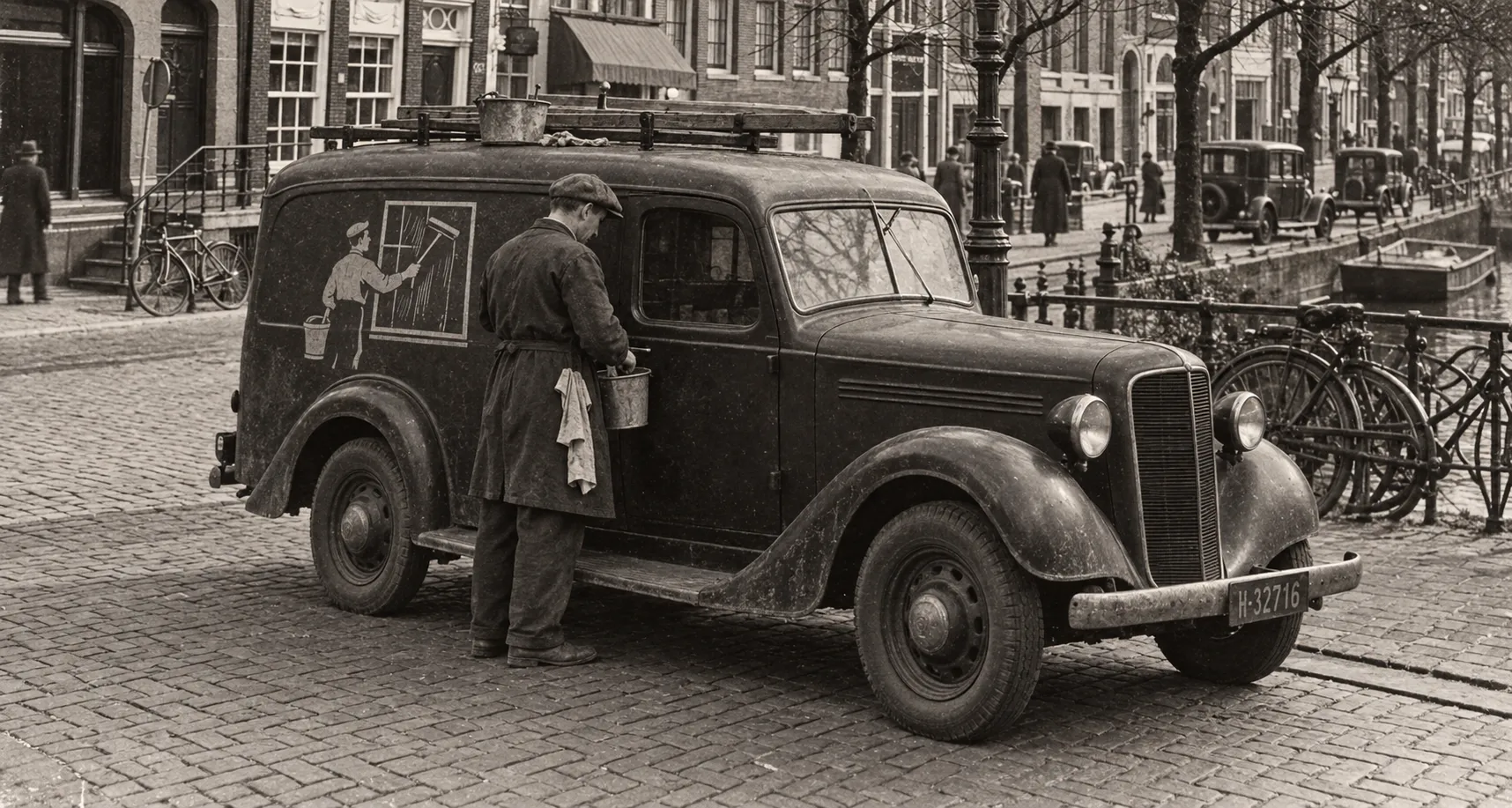
When you think of a window cleaner, you may picture a ladder, a bucket or a telescopic pole. Yet one small tool may have changed the trade more than any of them: the squeegee. With one rubber blade, a window cleaner can remove water and dirt in a controlled movement. It sounds obvious now, but the modern form is less than a century old.
From heavy metal to one flexible blade
In the early 1930s, window cleaners used much heavier wipers. One well-known Chicago model had a metal construction with two stiff pink rubber blades. It was solid, but not light or forgiving. The angle and pressure had to be just right, or water and streaks remained on the glass.
Ettore Steccone, an Italian window cleaner, believed there was a better way. Born in Mongiardino Ligure in 1896, he moved to the United States in 1922 and worked in Oakland. He knew the problem from the job itself: a window cleaner does not need a complicated device, but a tool that adapts to the glass.
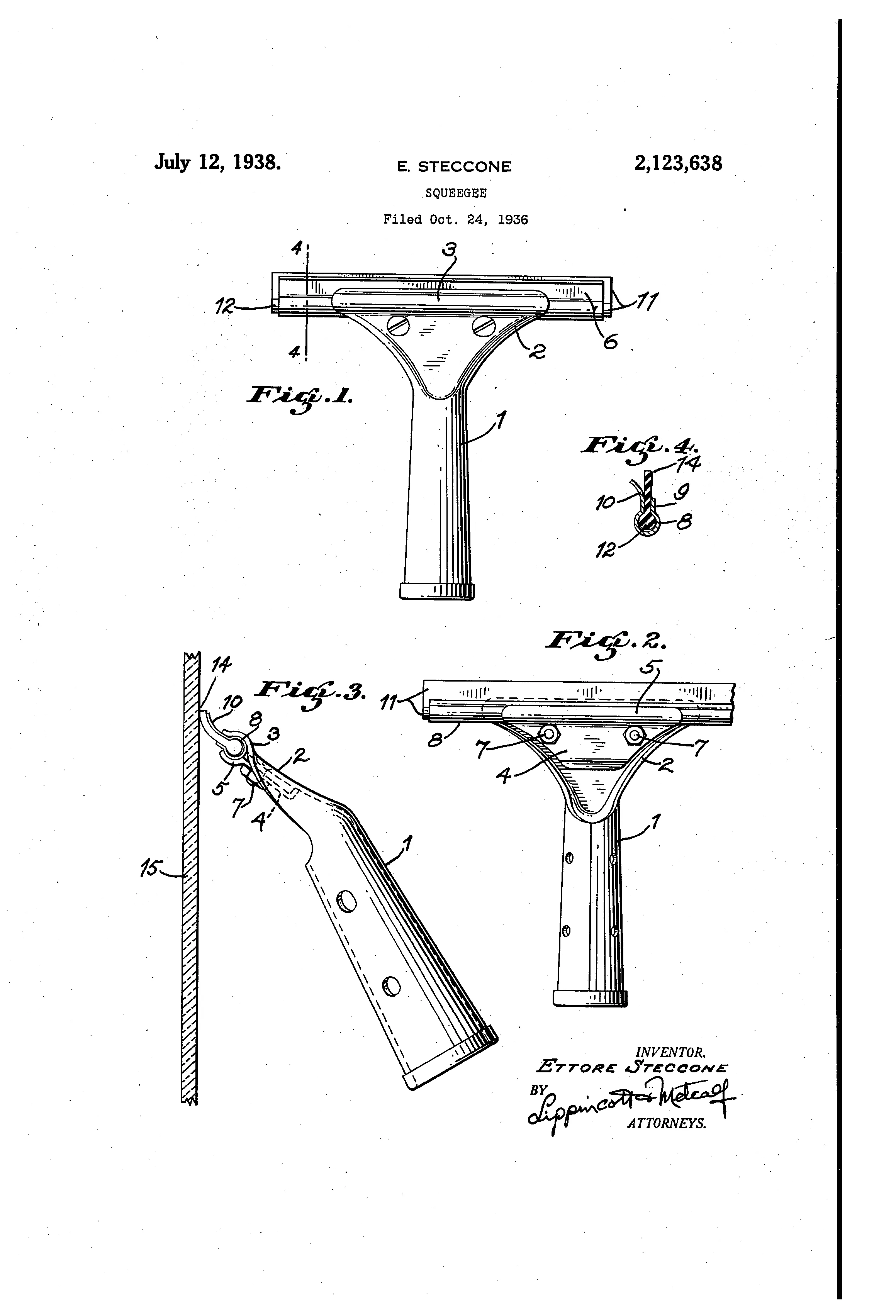
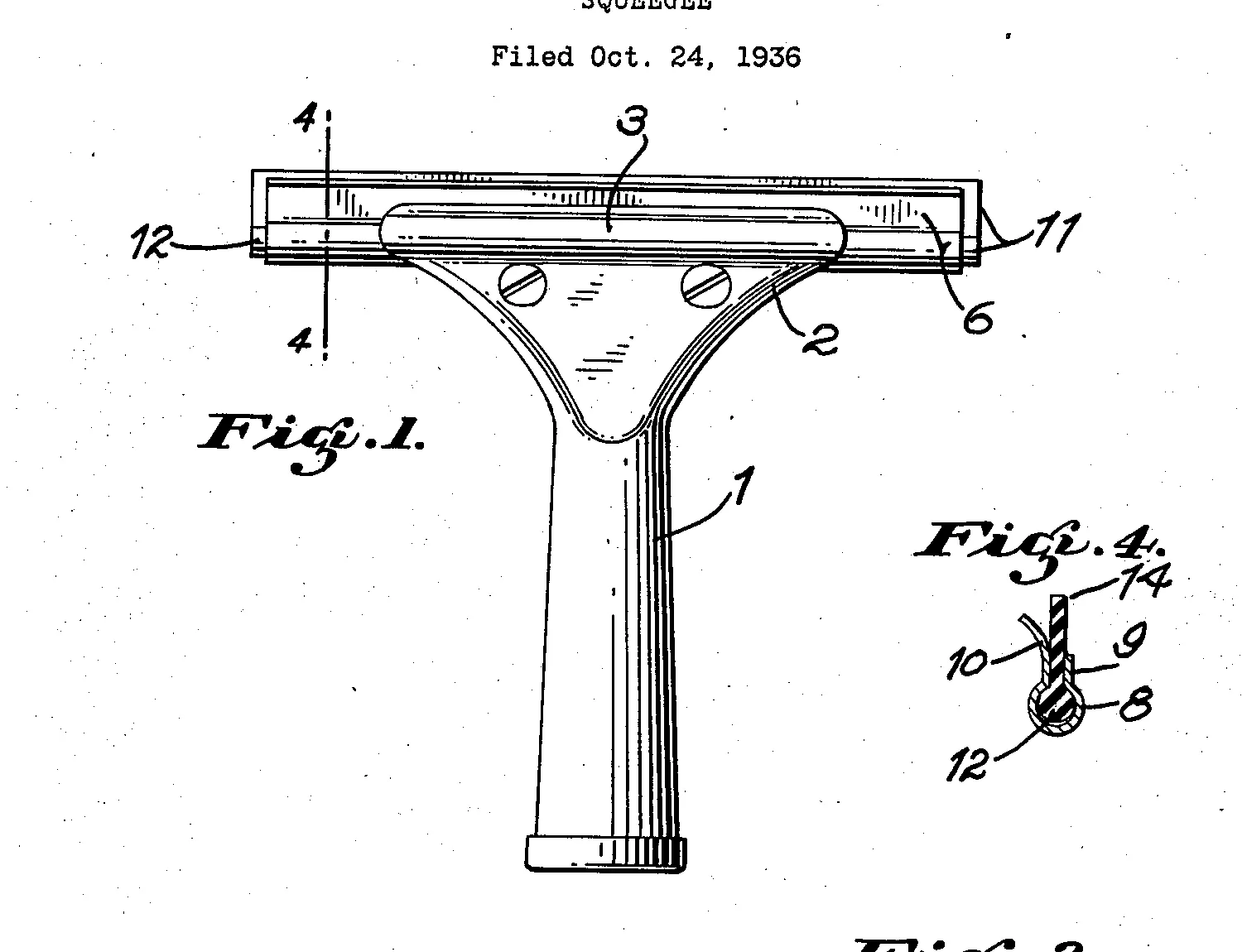
His answer was a light T-shaped tool with one flexible rubber blade. He called the design the New Deal. The difference was not only the weight. The rubber kept contact with the glass through a wider range of angles and pressure. A clean, streak-free pass became easier to achieve even when every movement was not identical.
The 1936 patent
Steccone applied for a patent on 24 October 1936. It was granted on 12 July 1938 as US Patent 2,123,638. People often shorten this to “the squeegee was invented in 1936”, but the precise wording is: the design was filed in 1936 and officially patented in 1938.
Steccone made the first examples in his garage. The story goes that he challenged fellow window cleaner J. Racenstein to try the new tool, with a hat at stake. Steccone also gave other cleaners a chance to test it. The first tools reportedly carried the words “at Racenstein”.
That is how trades change: not through a brochure, but when someone notices on a real workday that a tool is easier and more consistent. A factory followed in the early 1950s, and the family business still operates in the San Francisco Bay Area.
More than a cleaning tool
The squeegee became so recognisable that it entered popular culture. In 1936 George Formby sang When I’m Cleaning Windows. And after the attacks of 11 September 2001, Jan Demczur used a squeegee handle to help himself and others escape a stalled lift. That handle is now kept by the Smithsonian.
The everyday meaning is simpler. The squeegee made it possible to work faster, lighter and more consistently. That helped professional window cleaners serve homes, shops and offices at a practical scale.
What it means in Amsterdam
For commercial window cleaning in Amsterdam, the basics remain surprisingly simple: clean water, the right tool and a consistent technique. For high windows we also use a telescopic system with purified water. The squeegee is especially important for finishing and for windows cleaned from the inside.
A rubber blade must be clean, straight and able to move smoothly across the glass. That is often the difference between quickly wiping a window and leaving it properly clear. You can check the price of a window cleaner in Amsterdam before booking, then choose a date online.